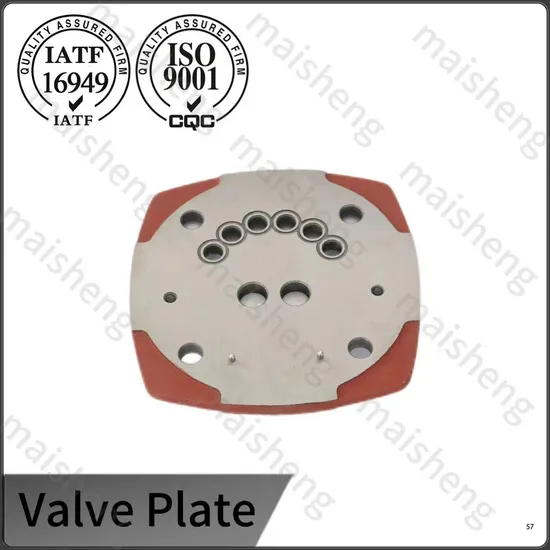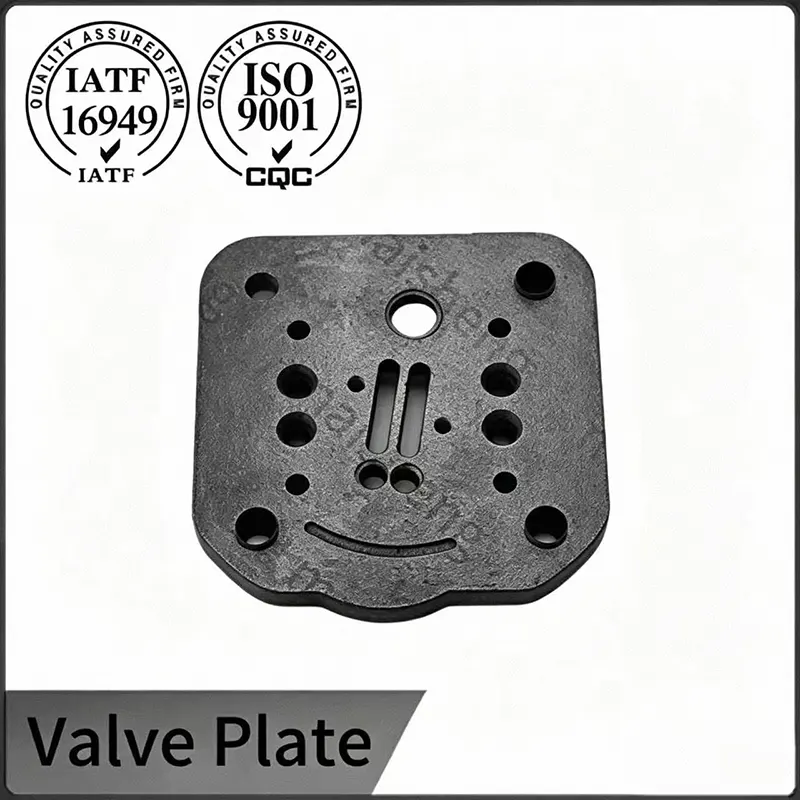

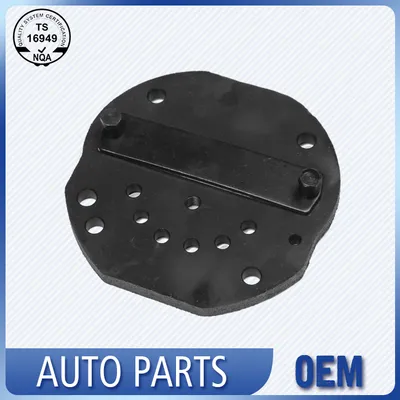
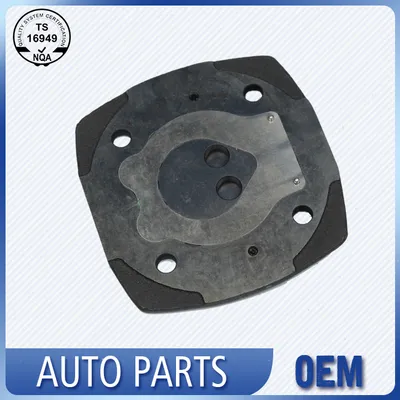
Powder metallurgy valve plate adopts mature powder compaction and sintering craftsmanship tailored for automobile air compressor matching demands. The homogeneous internal microstructure effectively eases partial stress concentration generated during frequent valve opening and closing cycles, lowering the risk of local deformation under continuous alternating pressure. Every finished piece is checked for flatness and hole position tolerance in line with auto accessory inspection standards, adapting to diverse actual assembly requirements of aftermarket replacement and regular accessory matching for multiple vehicle types.
Powder metallurgy valve plate features evenly distributed internal structure formed by powder sintering, which disperses alternating compression stress generated from repeated valve opening and closing in air compressors. This structural trait avoids partial stress buildup after long hours of cyclic operation and lessens the possibility of local bending or deformation under continuous dynamic pressure, effectively sustaining normal compression efficiency of automotive compressor assemblies under daily driving loads.
The starting material is a water atomized iron powder blended with 2 percent copper and 0.8 percent graphite, a composition selected for its ability to form a pearlitic microstructure with dispersed copper rich phases during sintering. Compaction is carried out on a hydraulic press at 600 MPa, giving the green compact sufficient density uniformity for predictable shrinkage. Sintering takes place in a mesh belt furnace under a nitrogen-hydrogen atmosphere at 1120 degrees Celsius for 25 minutes, allowing the copper to melt and infiltrate the iron particle boundaries. This liquid phase sintering mechanism closes residual porosity and raises the final density above 6.9 grams per cubic centimeter, while the interlocking particle network provides the fatigue strength needed for millions of valve cycles. A hardness sample is extracted from each furnace load and must land within 60 to 80 HRB, confirming the thermal profile remained consistent throughout the batch.
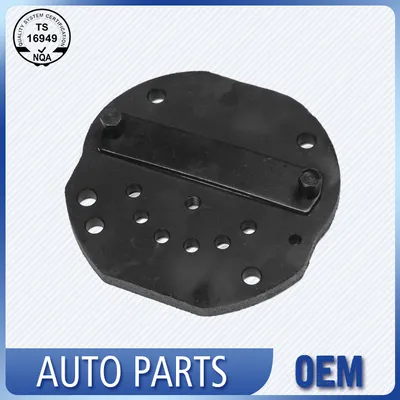
Powder metallurgy valve plate is designed referring to mainstream air compressor installation parameters of common passenger and light commercial vehicles. Multiple mature specifications cover most mainstream aftermarket replacement demands, and we can adjust structural parameters moderately to fit special compressor models according to clients’ detailed technical information.
After sintering, the plates undergo a double disc grinding operation that brings both faces within a 5 micron flatness tolerance and a parallelism of 0.02 millimeter. Surface roughness is held below Ra 0.8 micron, which minimizes gas leakage paths when the reed valve seats against the plate. A sample from each grinding batch is measured on a white light interferometer to confirm that the plateau texture is free of directional scratches. Hole positions are then checked on a vision measurement system with backlight illumination, referencing the outer diameter datum, and any hole center deviation larger than 0.05 millimeter triggers immediate tool offset correction. The final audit before packing involves a manual flatness check with a monochromatic light source and an optical flat, guaranteeing that no plate with detectable bow reaches the customer.
Production takes place within the same IATF 16949 certified facility that has manufactured precision automotive engine parts for over 25 years. The powder metallurgy cell maintains statistical process control charts on density, hardness and critical dimensions, with a Cpk target of 1.33 or higher on flatness and hole location. Batch genealogy is preserved from incoming powder lot number to finished plate inspection record, allowing any deviation found during field audit to be traced back to the specific pressing shift and furnace cycle. For OEM compressor programs, we submit a complete PPAP package that includes the process flow diagram, PFMEA, control plan and initial capability study, along with material composition certificates and sintered density reports.
1.What are the inherent limitations of powder metallurgy valve plates?
A: The structural compactness is weaker than solid cast iron and CNC aluminum alloy blanks. Long-term high-frequency strong impact will cause local material loosening and surface depression; the material tensile strength is limited, not suitable for 24-hour continuous heavy-load high-pressure compressors; the surface micropores are easy to absorb oil sludge and dust, requiring more frequent cleaning maintenance.
2.Is powder metallurgy valve plate a cost-effective alternative to aluminum and cast iron valve plates for intermittent light-load air compressors?
A: Very cost-effective. It has lower procurement cost than solid aluminum and cast iron valve plates, built-in self-lubricating performance reduces daily wear loss, and meets all performance demands of intermittent light-pressure equipment. It is not recommended for heavy-duty 24-hour continuous operation air compressors.
3.What maintenance schedule helps extend the service life of a powder metallurgy valve plate?
A: Inspect the plate during every compressor oil change interval, typically at 20,000 kilometers or 12 months. Remove any carbonized oil deposits from the surface with a soft brass brush and compressed air, taking care not to embed abrasive particles into the micropores. If the reed valve contact band shows a polished wear track deeper than 0.05 millimeter when checked with a profilometer, plan for replacement even if the plate still appears flat. Always fit a fresh gasket and torque fasteners in a diagonal sequence to the value specified on the compressor data sheet, because uneven bolt load will distort the plate and accelerate reed fatigue.
Address
NO.556,Kangzhuang South road, Jiangbei District,Ningbo City, Zhejiang China
Tel
If you have any enquiry about quotation or cooperation, please feel free to email us at huyanping@nbmachinery.com or use the following inquiry form.Our sales representative will contact you within 24 hours. Thank you for your interest in our products.