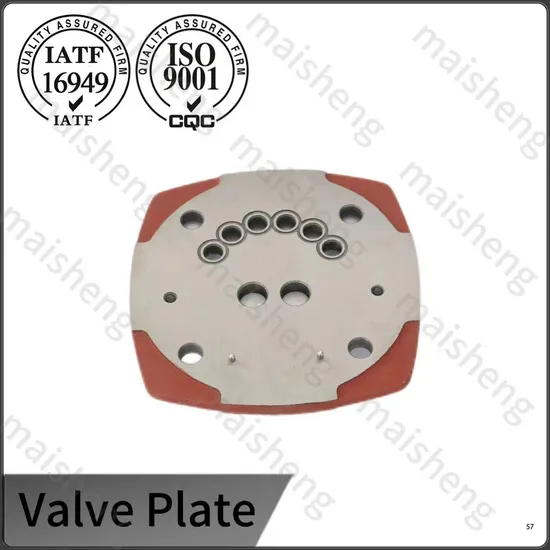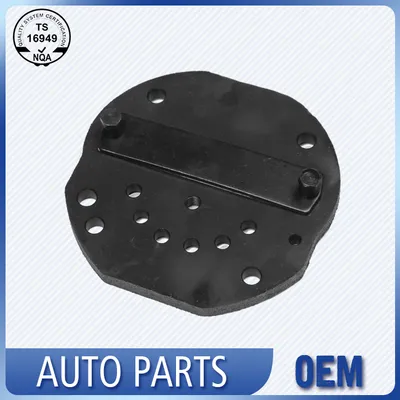

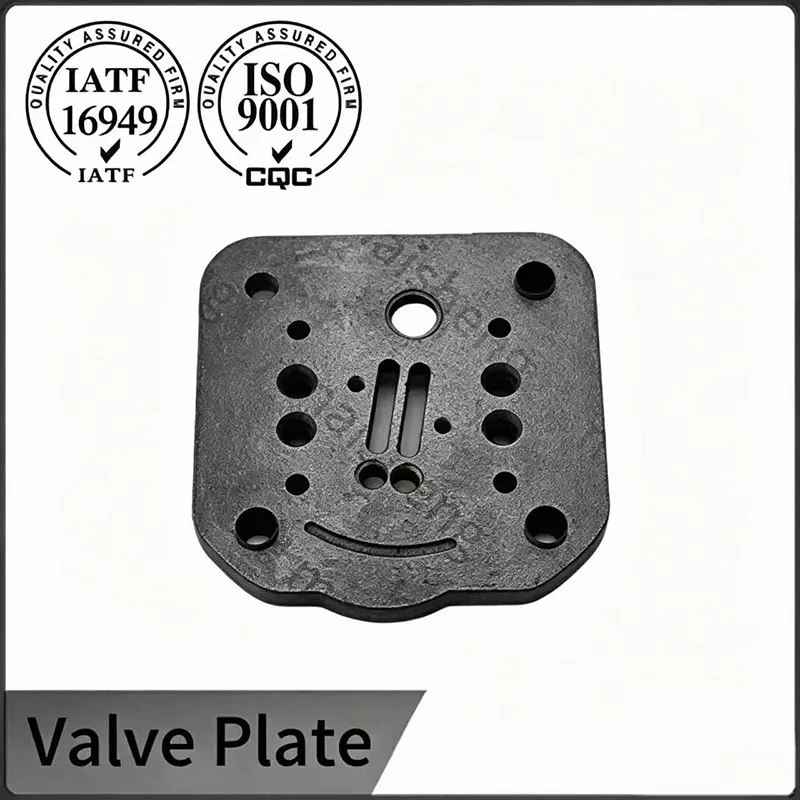
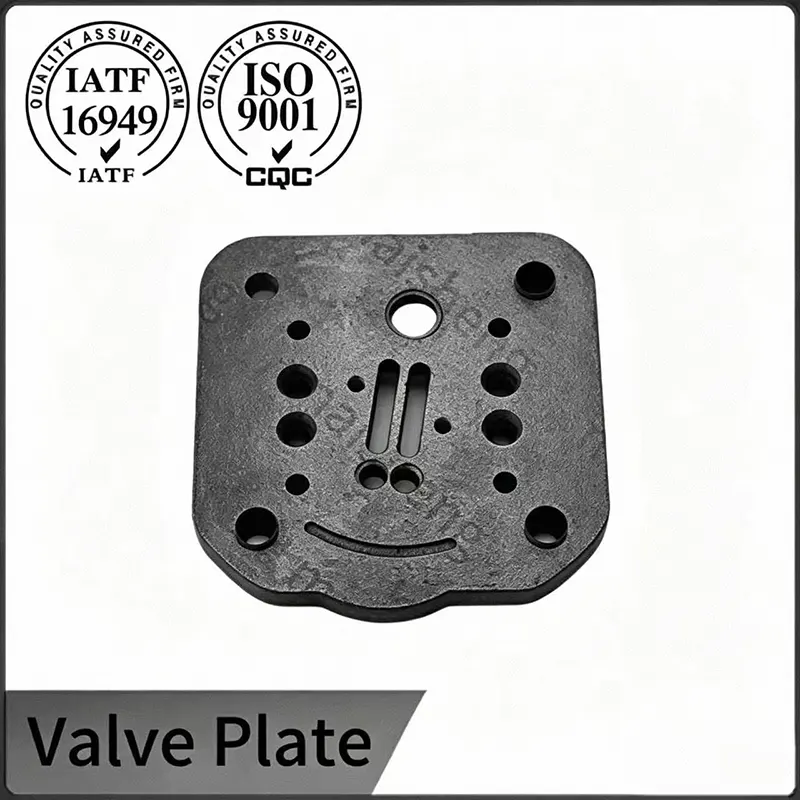
Our cast iron valve plate boasts diversified structural layouts tailored for assorted automotive air compressor assemblies covering passenger and commercial vehicle models. Every piece undergoes refined bore machining and precise contour finishing to tighten mounting tolerance, enabling sustained airtight sealing against frequent pressure fluctuation and cyclic compression loads during long-term vehicle operation. A full range of standard specifications are kept in stock for quick bulk shipment, meanwhile customized dimensional redesign is supported to satisfy unique fitting demands of various aftermarket and OEM compressor configurations across global markets.
The plates are cast from a gray iron conforming to HT250 grade, with a minimum tensile strength of 250 MPa measured on separately poured test bars. A resin bonded sand molding process is employed to achieve a smooth surface finish and consistent section thickness across the bolt bosses and port openings. Inoculation treatment applied during the pouring stage refines the graphite flake distribution to Type A in a fully pearlitic matrix, which gives the material its stiffness and natural vibration damping capacity. After shakeout, the raw castings pass through a stress relieving furnace at 550 degrees Celsius for a controlled soak, removing residual strains from the cooling process and stabilizing the part geometry prior to machining.
Cast Iron Valve Plate is structurally optimized to offset continuous mechanical vibration transmitted from vehicle engine and compressor linkage during driving. Well-proportioned internal hole distribution helps disperse recurring vibration stress evenly across the whole component, preventing gasket displacement and air leakage triggered by prolonged bumpy road travel. Such vibration-resistant features keep matched air compressors maintain steady compression performance under varied pavement conditions from urban roads to rough mountain routes.
Bore finish and surface flatness directly influence the sealing capability of the valve plate. After the stress relief cycle, the plates are located on a CNC machining center where all bolt holes are drilled and tapped in a single fixturing, maintaining a hole-to-datum position tolerance of 0.05 millimeter. The sealing face is then lapped to a flatness of 0.01 millimeter per 100 millimeter length, verified under a monochromatic light source and optical flat. A profilometer check confirms the surface roughness stays below Ra 0.6 micron, reducing microscopic leak paths that could degrade compressor volumetric efficiency. Final audit samples are assembled with a test gasket and pressurized to 1.2 times the rated working pressure under water, with zero bubble emission required for acceptance.
Cast Iron Valve Plate owns stable physical property to avoid warping or dimensional distortion during long-term warehouse storage and long-distance international shipment. Consistent forming process keeps finished products stay in fixed outline under ordinary ambient temperature and humidity, reducing abnormal reject loss caused by part deformation in bulk packing and cross-border transportation for global auto parts dealers.
The entire production line operates within an IATF 16949 certified management system backed by more than 25 years of experience in precision automotive component manufacturing. Each batch of incoming raw iron is verified using optical emission spectrometry against the material certificate, and the chemical composition is archived alongside the melt number. Machining process parameters are monitored with statistical control charts, and capability indices for critical dimensions are maintained above 1.33. Every finished plate carries a permanent batch code that links back to the casting heat number, the stress relief cycle chart, the CNC program revision and the final inspection report. This traceability structure supports complete PPAP level 3 submissions for compressor OEM programs, including process flow diagrams, PFMEA documents and material certifications.
1.Which types of equipment are cast iron valve plates suitable for?
A: They are mainly used for heavy-duty industrial piston air compressors, engineering vehicle brake air pumps, large stationary air supply compressors, and equipment with long-time continuous full-load operation. It targets high-vibration, high-pressure working scenarios where aluminum alloy plates cannot maintain long-term dimensional stability.
2. The compressor still leaks air after replacing a new cast iron valve plate, what is the reason?
A: It is rarely a quality defect of the new valve plate. Main reasons include unpolished rust and carbon residue on cylinder fitting surface, deformed cylinder head sealing plane, failure to replace matched intake and exhaust reeds synchronously, and inconsistent bolt tightening torque during assembly. Clean contact surfaces, renew valve reeds and calibrate torque to eliminate leakage.
3.What is the recommended bolt torque and tightening sequence for a cast iron valve plate?
A: Refer to the compressor service manual for the exact value, typically 10 to 15 Nm for M6 fasteners in cast iron. Tighten the bolts in a diagonal pattern in two stages, first to half the target torque, then to the final value. After the first 10 hours of operation, recheck the torque with a calibrated wrench while the cylinder head is at ambient temperature. Even bolt loading prevents the plate from warping and ensures uniform reed contact across the entire sealing perimeter.
4.How can a workshop visually inspect a cast iron valve plate before installation?
A: Place the plate on a known flat surface such as a granite block and attempt to rock it by hand, any perceptible wobble indicates residual distortion. Examine the thread condition with a go gauge, and run a clean finger across the sealing face to detect scratches or pitting. Check the bolt hole edges for burrs and remove them with fine emery cloth if present. A plate that passes these simple checks and shows no visible cracks when illuminated at an angle is ready for installation.
Address
NO.556,Kangzhuang South road, Jiangbei District,Ningbo City, Zhejiang China
Tel
If you have any enquiry about quotation or cooperation, please feel free to email us at huyanping@nbmachinery.com or use the following inquiry form.Our sales representative will contact you within 24 hours. Thank you for your interest in our products.